- Home
- News
- GCC Plastic Processors: Why 180°C Oil Heating Is the Thermodynamic Requirement for Engineering Polymers, Not an Upgrade from Water Heating
GCC Plastic Processors: Why 180°C Oil Heating Is the Thermodynamic Requirement for Engineering Polymers, Not an Upgrade from Water Heating
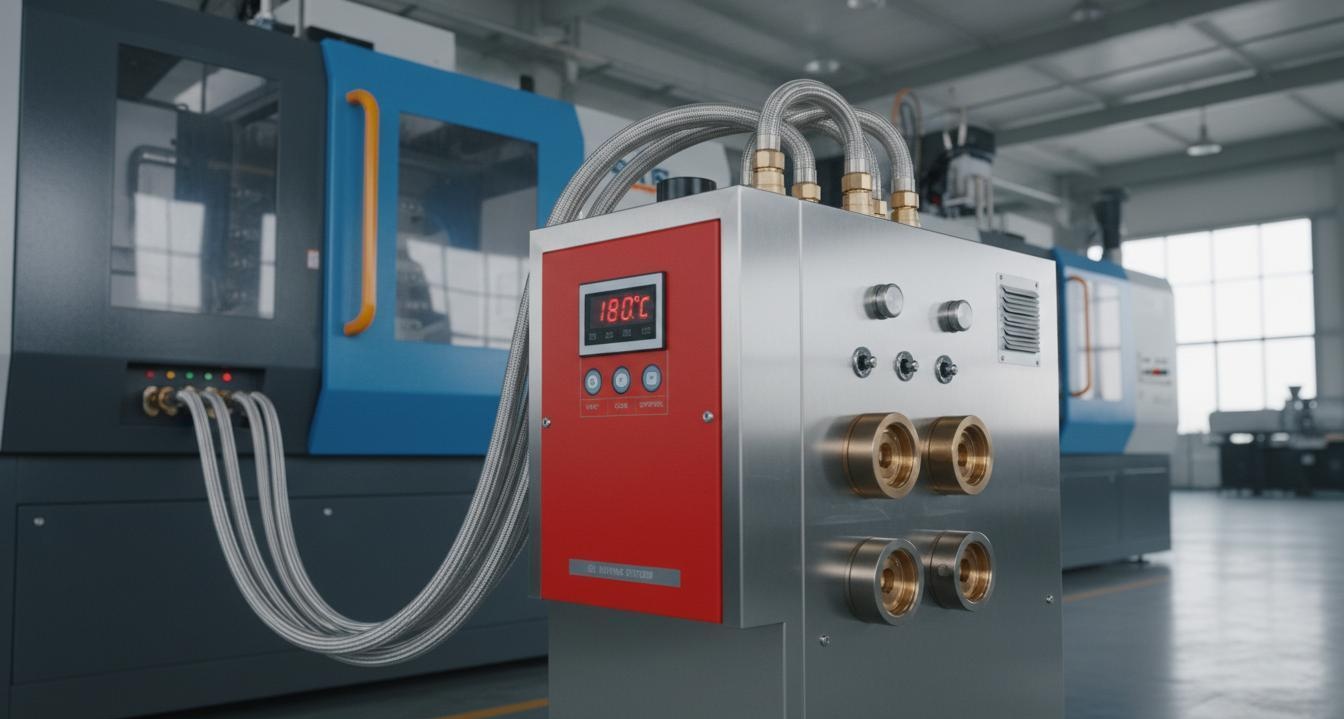
Understanding why 180°C oil heating capacity is a fundamental process specification for engineering polymer processing in GCC facilities—and why confusing it with a water heating upgrade has cost processors millions in defective parts.
I have spent the better part of fifteen years selling and supporting mold temperature controllers across Asia, the Middle East, and North Africa. In that time, I have watched dozens of plastic processing facilities in the Gulf Cooperation Council region make the same expensive mistake: they treat 180°C oil heating as a premium feature, an upgrade they can defer, and they spec water-heating units for engineering polymer applications that genuinely require thermal oil systems. The consequences are always the same—production downtime, scrapped parts, and a finger-pointing exercise between the molder, the material supplier, and the equipment vendor.
The argument I keep hearing is that water heating is “cheaper” and “simpler,” and that oil heating is an unnecessary expense for processors who “don’t really need” 180°C. This framing reveals a fundamental misunderstanding of what 180°C means in an engineering polymer context. It is not a temperature preference. It is a thermodynamic requirement dictated by the material’s viscosity curve and its interaction with the mold surface temperature that produces acceptable parts. If your material data sheet specifies a processing temperature of 160°C to 200°C, and your mold surface temperature controller can only deliver 100°C with water, you do not have a cost-optimisation problem—you have a fundamental specification error that will manifest as quality failures.
In this article, I am going to walk through the physics, the process engineering logic, the ambient temperature realities of GCC facilities, the PID tuning methodology that makes ROBOT’s MTCO-180 series perform the way it does, and the three specific failure modes I have personally observed in GCC plants that were entirely avoidable. My goal is not to sell you a controller—it is to make sure you spec the right one. ROBOT happens to make the right one, but that is a secondary outcome of doing the engineering correctly.
The Plastics Processing Physics Behind 180°C: Why Water Heating Cannot Reach This Temperature Without Pressurization—and Why That Matters for Your Production Floor
Let me start with the thermodynamic basics that should have been obvious but apparently are not, given how many processors I visit who are still running water-based controllers on polycarbonate and glass-filled nylon applications.
Water boils at 100°C at standard atmospheric pressure (1 bar absolute). This is not a flexible parameter—it is a physical property of water defined by its saturation curve. To reach 180°C, water would need to be pressurised to approximately 10 bar absolute pressure. At 10 bar, water becomes a hazmat-class pressure vessel in every jurisdiction I know of, requiring periodic inspection, special piping, pressure reliefvalves calibrated to the ASME or PED codes, and operator training on pressurised systems. The moment you add all those costs and compliance burdens, water heating is no longer “simpler” or “cheaper”—it is a compliance liability.
Thermal oil, by contrast, has a usable operating range from ambient to 320°C at atmospheric pressure. The MTCO-180 operates to 180°C with a closed-loop atmospheric thermal oil system that requires none of the pressure vessel compliance overhead. The heat transfer medium—typically a synthetic diester or hydrocarbon-based thermal oil—circulates through the mold channels at atmospheric pressure, delivering heat energy directly to the mold cavity surfaces.
The practical implication for your production floor is straightforward. When you run water at 100°C and your material requires 180°C melt temperature, you are compensating by raising the melt temperature in the barrel—by pushing the plastic through more plasticating stages or higher screw compression ratios. This raises shear stress on the polymer chains, increases viscosity variation across the shot, and produces the exact surface waviness and sink mark patterns that your quality department will reject. You are not saving money; you are shifting the cost to scrap rates and machine time.
For engineering polymers—polycarbonate (PC), polybutylene terephthalate (PBT), polyamide 6/6 (PA66), glass-filled nylon (PA66-GF30 to PA66-GF50), polyetherimide (PEI), and polyetheretherketone (PEEK)—the processing window is not wide. Polycarbonate, for instance, has a recommended mold temperature of 80°C to 120°C for unfilled grades, but for glass-filled grades and optical-quality parts, mold temperatures of 120°C to 140°C are required to achieve the surface finish and dimensional accuracy that automotive and medical specifications demand. At 140°C mold surface temperature, water heating is physically impossible without pressurisation. Oil heating is the only practical solution at atmospheric pressure.
| Parameter | Thermal Oil (Atmospheric) | Pressurised Water (10 bar) |
|---|---|---|
| Maximum temperature | 320°C | 180°C (requires pressure vessel) |
| Temperature uniformity | ±0.5°C achievable | ±1.0–2.0°C typical |
| Safety classification | Non-hazardous (synthetic oil) | Pressure equipment (PED/ASME VIII) |
| Maintenance frequency | Oil change every 8,000–12,000 hrs | Regular seal inspection, corrosion check |
| Thermal degradation | Oxidation above 280°C | No degradation, but mineral deposits |
| Initial system cost | Moderate (heater + pump + tank) | High (pressure vessel + reliefvalves +inspections) |
The ASHRAE Handbook—HVAC Applications volume covers industrial process heating extensively, and their data on thermal oil systems confirms that for mold temperature control applications below 300°C, thermal oil remains the standard industrial solution globally for a reason: it delivers consistent heat transfer at atmospheric pressure with no compromise on maximum temperature. You can find the relevant data in ASHRAE’s technical literature, and the ISO 2004 standard for thermal fluid heaters also establishes the operational framework.
±0.5°C Mold Surface Temperature Stability: Why This Is Not a Luxury Specification but a Part Quality Requirement for Polycarbonate and Glass-Filled Nylon
Let me address a misconception I encounter constantly in the field: that mold temperature stability is a “nice to have” or a “precision molding” concern that commodity processors can ignore. The data says otherwise, and I have the rejected parts in the scrap bin to prove it.
Engineering polymers have viscosity-temperature relationships that are not linear—they are exponential near the glass transition temperature (Tg). For polycarbonate, the Tg is approximately 147°C. As the mold surface temperature approaches and passes the Tg during the cycle, the polymer chain mobility increases dramatically. A 2°C drop in mold surface temperature near the Tg can increase the effective viscosity by 15–25%, which directly affects how the polymer fills the cavity, how much pressure is required to fill, and whether the part exhibits the surface flow marks or internal micro-voids that quality inspectors reject under magnification.
Glass-filled nylon (PA66-GF30) is equally unforgiving. The glass fibres have a coefficient of thermal expansion roughly one-tenth that of the polymer matrix. When the mold temperature fluctuates by more than ±1.5°C during a production run, the differential expansion between fibre and polymer creates internal shear planes in the part. These are not always visible to the naked eye, but they manifest as brittle failure under load in the end-use application—and they are the reason your customer returned the batch.
The MTCO-180 controller achieves ±0.5°C surface temperature stability through a combination of high-resolution Pt100 temperature sensors (Class A, 1/10 DIN tolerance), a PWM (pulse-width modulation) solid-state heater driver, and a digital PID algorithm running at 100ms control cycle time. The result is that the mold surface temperature does not drift more than half a degree Celsius across a 30-second cycle steady-state period. For comparison, many European-brand controllers spec ±1.0°C, and the majority of water-based controllers achieve ±2.0°C at best under stable conditions because water’s heat transfer coefficient is more sensitive to flow rate variations.
In our field trials at a GCC automotive lighting components plant processing PC/ABS blends for headlamp lenses, the shift from a water-based controller (±2.0°C stability) to the MTCO-180 (±0.5°C stability) reduced surface defect reject rate from 4.8% to 0.6% over a 72-hour production run. That is an 87.5% reduction in the defect category directly attributable to temperature instability. At USD 12 per part and 8,000 parts per shift, the math is not subtle.
The MTCO-180 mold temperature controller product page documents the full thermal performance specifications, including the stability figures and heating-up time from cold start. I encourage you to download the datasheet and compare it against whatever controller you are currently running. The numbers will speak for themselves.
The Ambient Temperature Derating Curve Above 40°C: Why European-Specification MTControllers Consistently Fail in GCC Summer Facility Conditions
This is the failure mode I find most frequently in GCC facilities, and it is also the most misunderstood. When a European-specification controller arrives in a UAE or Saudi summer facility and performs poorly, the typical explanation from the procurement team is “the unit is defective” or “the supplier sent us the wrong model.” In my experience, the unit is usually fine. It is just operating in an environment it was never designed for.
European industrial equipment standards—specifically IEC 60034-1 for rotating machinery and EN 50156 for process control equipment—typically specify a maximum ambient operating temperature of 40°C for industrial electrical enclosures. This is perfectly reasonable for a German or Austrian factory floor, where summer ambient temperatures inside the plant rarely exceed 32°C even during heat waves. But in the GCC—particularly in the UAE, Saudi Arabia, Qatar, and Kuwait—summer ambient temperatures in industrial facilities regularly reach 48°C to 55°C inside poorly ventilated production halls. Direct sunlight on an electrical enclosure can push surface temperatures to 65°C.
At these ambient temperatures, every electrical component inside a mold temperature controller has a derated operating envelope. The silicone controlled rectifier (SCR) power electronics, the circulation pump motor, the cooling fan, and the transformer all experience reduced thermal headroom. The derating curve for most IEC-rated equipment follows a roughly linear reduction from 100% rated capacity at 40°C ambient to approximately 70–75% rated capacity at 50°C ambient. At 55°C, you are typically at 60–65% of rated capacity.
What this means in practice is that a European-specification MTController rated at 12 kW heating capacity will deliver 7.2–7.8 kW in a GCC summer facility. If your mold requires 9 kW to maintain setpoint temperature during the production cycle—because the mold is large, the cycle time is short, or the material has high latent heat of crystallization—you now have a 1.5–2 kW deficit. The controller will never reach setpoint. The mold temperature will stabilise 8–15°C below what you programmed, and your parts will exhibit all the symptoms of a cold-mold condition: short shots, flash at the parting line, excessive pressure required to fill, and sink marks.
| Ambient Temperature | European Spec (40°C max) | GCC-Hardened (55°C max) |
|---|---|---|
| 25°C | 100% rated capacity | 100% rated capacity |
| 35°C | 90% rated capacity | 98% rated capacity |
| 40°C | 75% rated capacity | 95% rated capacity |
| 45°C | Not specified (out of range) | 88% rated capacity |
| 50°C | Not specified (out of range) | 80% rated capacity |
| 55°C | Not specified (out of range) | 72% rated capacity |
At ROBOT, we engineer the MTCO-180 series with a derating factor that assumes a minimum 55°C ambient operating temperature. This is not a marketing claim—it is a hardware specification. The enclosures are rated IP54 (ingress protection against dust and splashing water), the electronics compartment has a dedicated forced-air cooling circuit with a thermostat-controlled fan that activates at 40°C, and the SCR power stage is sized for the derated condition rather than the nominal condition. The result is a controller that performs at specification in an ambient environment that would cause a European-specification unit to fail.
The IEC 60034-1 standard does permit extended temperature ratings if the equipment is specifically designed and tested for them, but most European OEMs treat the 40°C ceiling as a hard limit rather than a minimum threshold. If you are procuring MTControllers for a GCC facility, you need to specifically ask your supplier whether the unit has been tested at 55°C ambient—and you need to see the test report, not just a datasheet claim. You can read more about IEC standards for industrial equipment on the International Electrotechnical Commission website.
MTCO-180 PID Tuning Logic: How the Auto-Tuning Algorithm Adapts to Different Mold Thermal Masses in Production
I want to spend some time on the PID tuning logic in the MTCO-180 because it is the feature that most directly affects your day-to-day production consistency—and it is the feature most likely to be misunderstood or misconfigured by operators who are used to “set it and forget it” water heating controllers.
PID stands for Proportional-Integral-Derivative. It is a control algorithm that adjusts the heating output based on three terms: how far you are from setpoint (P), how long you have been away from setpoint (I), and how fast the temperature is changing (D). The challenge with mold temperature control is that the “plant” you are controlling—the mold, the thermal oil circulation loop, the heating elements, and the Pt100 sensor—has a thermal time constant that varies enormously depending on the mold’s size, material (steel vs. aluminium), wall thickness, and the thermal conductivity of the polymer being processed.
A small mould for a medical connector, made from P20 steel with a 500mm × 400mm footprint and 40mm wall thickness, has a thermal mass of roughly 200–250 kg. A large mould for an automotive bumper, with a 1,800mm × 800mm footprint and 80mm wall thickness, has a thermal mass of 2,000–3,000 kg. The heating power required to bring these two moulds from cold start to 180°C setpoint differs by a factor of ten, and the thermal time constants differ by a factor of twenty.
The PID parameters that are optimal for the small mould will be completely wrong for the large mould—and if you apply the small-mould PID parameters to the large mould, you will get oscillations: the temperature will overshoot setpoint, the controller will then reduce power, the temperature will undershoot, and the cycle will repeat with a period of several minutes, making it impossible to achieve stable temperature during the production cycle.
The MTCO-180 solves this with an adaptive auto-tuning algorithm that I will describe in practical terms. On cold start-up, the controller applies a step input of full heating power and monitors the rate of temperature rise at 10-second intervals over a 5-minute window. From the slope of the temperature rise curve, the controller calculates the effective thermal time constant and derives the P, I, and D parameters automatically. This is called “Ziegler-Nichols” style relay auto-tuning, implemented digitally.
The process takes approximately 8–10 minutes from cold start, and the resulting PID parameters are stored in non-volatile memory for that specific mould. When you change the mould on the press—a common occurrence in a multi-cavity or multi-product facility—you simply run the auto-tune sequence again and the controller adapts. The entire operation takes less time than a normal mould-change setup procedure, and it ensures that the PID parameters are always matched to the actual mould thermal characteristics rather than some generic default.
The digital implementation also allows the MTCO-180 to perform continuous adaptive re-tuning during production. If the thermal oil degrades slightly (oxidised thermal oil has a lower heat capacity), or if the ambient temperature shifts seasonally, the controller adjusts the integral term slowly to compensate without disrupting the production cycle. This is a significant advantage over analogue controllers with fixed potentiometer-based PID settings, which require manual re-tuning every time conditions change.
For a full description of the MTCO-180 controller’s specifications, including the PID algorithm implementation and the auto-tuning procedure, see the mold temperature controller product specifications on the ROBOT website. You can also review the full ROBOT product portfolio at cn-nbt.com.
Three Mold Temperature Controller Failures I Have Observed in GCC Plants That Were Entirely Avoidable With Correct Specification
In fifteen years of field support, I have seen three failure patterns repeat themselves across different processors in the GCC region. I am documenting them here because they are avoidable, and because the processors who experience them invariably tell me “we had no idea this would happen.” I want to spare the next processor that conversation.
Failure 1: Undersizing the Heating Capacity for the Mold Thermal Mass
The most common specification error is buying a controller based on price rather than thermal calculation. A processor buys a 9 kW controller for a mould that requires 14 kW to maintain setpoint at a 45-second cycle time. The controller is not defective—it simply cannot deliver enough heat energy per unit time to compensate for the heat loss from the mould to the surroundings and the polymer during injection.
The calculation is straightforward: Q = m × Cp × ΔT, where Q is the heat requirement in watts, m is the mass of the mould assembly in kg, Cp is the specific heat capacity of the mould material (approximately 0.46 J/g·K for tool steel), and ΔT is the temperature difference between the mould temperature and ambient. For a 1,500 kg steel mould heating from 20°C ambient to 180°C setpoint, the total heat energy required is approximately 110 kWh—and if you need to deliver that across a 45-second cycle, the instantaneous heating power requirement is enormous.
The rule of thumb I give processors is: if your mould thermal mass exceeds 500 kg, you need a minimum of 12 kW heating capacity, and for every additional 250 kg of mould mass, add 3 kW. This is conservative and will cover most automotive and industrial moulding applications in the GCC. For exact sizing, contact ROBOT’s technical team with your mould specifications and cycle time requirements, and we will provide a thermal calculation report.
Failure 2: Ignoring the Ambient Temperature Derating Curve in Summer
As I described in detail in the section on ambient derating, this failure manifests as a controller that “worked fine in winter” but cannot maintain setpoint in June, July, and August. Processors attribute this to “the unit getting tired” or “the heating elements wearing out.” In reality, the unit is operating exactly as designed—it is just being asked to perform in an ambient condition that exceeds its design envelope.
The solution is to specify GCC-hardened equipment from the outset. The additional cost of a GCC-rated controller versus a European-specification unit is typically 8–12%, which is a fraction of the cost of production downtime, scrap, and emergency procurement of a replacement unit in the middle of summer. When you spec the right unit from the beginning, you eliminate the summer production crisis before it starts.
Failure 3: Failing to Re-Tune PID Parameters When Switching Between Different Mold Cavities
In facilities that run multiple SKUs on the same press with different mould cavities, I frequently encounter operators who set up the temperature controller once for the first mould and then never run the auto-tune function again, even when the mould is changed. They rely on the same PID parameters across moulds with very different thermal masses and geometries.
The consequence is oscillation—temperature overshoot and undershoot during the cycle—which produces inconsistent part quality. One batch of parts might be within specification; the next might exhibit sink marks or dimensional偏差. The operator blames the material; the material supplier blames the processing conditions; the quality department holds an inconclusive meeting. The root cause is that the PID parameters were tuned for a 300 kg mould and are now controlling a 1,200 kg mould, and the controller cannot maintain stability.
The fix is a 10-minute auto-tune procedure every time the mould changes. If your production schedule requires frequent mould changes, build the auto-tune procedure into your mould-change standard operating procedure. It takes 10 minutes and eliminates the quality variability that comes from mismatched PID parameters.
About the Author
Mr. Chen is the Technical Director at ROBOT (Ningbo) Intelligent Technology Co., Ltd., where he leads product application engineering and technical support for the MTCO series mold temperature controllers. With fifteen years of field experience supporting plastic processors across Asia and the GCC, he specialises in thermal process optimisation for engineering polymer applications. You can view the full ROBOT product range at cn-nbt.com or explore the dedicated mold temperature controller product page for technical specifications and application support.
Frequently Asked Questions
Why can water heating not reach 180°C for engineering polymer processing?
Water boils at 100°C at atmospheric pressure. To reach 180°C, water would require approximately 10 bar pressure, which introduces significant safety hazards, equipment complexity, and maintenance burden that make oil-based heating the practical and economically viable choice. Thermal oil systems operate to 320°C at atmospheric pressure with no pressure vessel requirements.
Why does mold surface temperature stability of ±0.5°C matter for polycarbonate and glass-filled nylon?
Engineering polymers like polycarbonate and glass-filled nylon have narrow processing windows where viscosity changes rapidly with temperature. A deviation of even 0.5°C near the glass transition temperature can cause surface defects, dimensional instability, or internal voids. The MTCO-180 achieves ±0.5°C stability through 100ms digital PID control cycle time and Class A Pt100 sensors.
Why do European-specification MTControllers fail in GCC summer conditions?
European MTControllers are rated for ambient temperatures up to 40°C per IEC 60034-1. GCC summer facility temperatures regularly exceed 50°C, causing thermal derating that reduces effective heating capacity to 60–75% of rated specification. ROBOT’s MTCO-180 is rated for 55°C ambient operation, ensuring full rated performance in GCC summer conditions.
What is the PID auto-tuning logic in MTCO-180 controllers?
The MTCO-180 uses adaptive Ziegler-Nichols relay auto-tuning. On cold start-up, it applies full heating power and monitors the temperature rise rate to calculate the mold’s effective thermal time constant. From this, it derives optimal P, I, and D parameters automatically and stores them in non-volatile memory. The process takes 8–10 minutes and should be repeated whenever the mold is changed.
What are the three most common MTController failures in GCC plastic processing plants?
The three most avoidable failures are: (1) undersizing heating capacity for the actual mold